
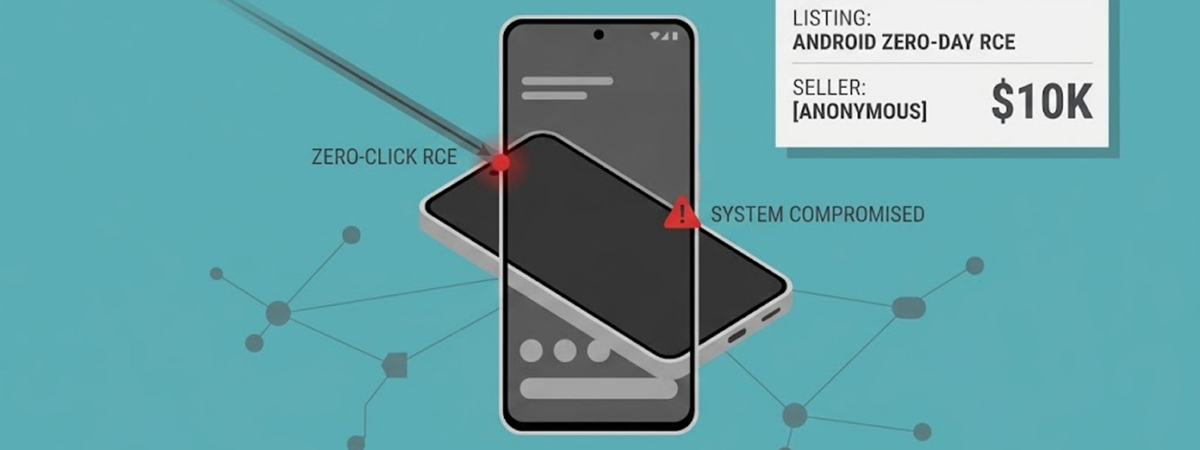
- A dark web operator, xynapse, offers an unconfirmed zero-day exploit chain for Android versions 14 to 16 at a price of $10,000.
- According to a statement from the seller, the chain allows remote code execution and escaping the sandbox without getting any download from the user.
- The advertisement said that tests were successful on high-performing devices such as Galaxy S24 and Pixel 9 but included the main modules needed for the bypass only as compiled binaries.
An individual operating under the username xynapse has released an advertisement on an underground platform. The threat actor claims that they are selling a brand-new zero-day exploit chain targeting mobile devices built on Android versions 14, 15, and 16.
According to the ad, the exploit chain has been designed to exploit vulnerabilities in Google Chrome and Android WebView systems. Cybersecurity researchers emphasize that these unverified claims represent significant operational risks for modern mobile security frameworks.
Several Phases of Execution with the Zero-Click Code
According to the dark web post from the seller, the exploit package executes arbitrary commands without requiring victim interaction. The threat actor claims the attack chain functions seamlessly when victims load malicious web pages inside Chrome or third-party apps. Consequently, targeted users do not need to download or install secondary application files to trigger complete system compromise.
From a technical perspective, the developer created the attack to follow various stages of execution automatically. First, the browser receives a redirect to execute remote code in the renderer environment. Then, the secondary components perform complete sandbox escape from the app boundaries to gain local user privileges.
Moreover, the merchant provides a collective software payload including JavaScript components, native shellcode, loaders, and a command-and-control stub. The whole attack sequence takes place in memory, helping to avoid typical antivirus detection methods based on disk analysis. As a result, defense systems can’t catch binary artifacts or produce standard file signature notifications during a memory attack.
Attackers have used similar techniques to conceal malicious code from security software, including campaigns that abuse signed Node.js binaries to hide malware from antivirus tools.
Verified Hardware Testing and Binary Obfuscation Concerns
Also, in the advert, the seller claims to be successful in performance testing against a few current leading smartphones. The successful test target models include the Google Pixel 9 series, Samsung Galaxy S24, and Xiaomi 14 hardware platforms. The seller is ready to provide serious clients with proof-of-concept testing videos as proof of technical ability of the software privately.
Nonetheless, the cybercriminal limits the source code delivery of some critical mitigation-bypassing components. The bypass tools of both Pointer Authentication Code and Security-Enhanced Linux are delivered in the form of compiled binary files. By providing these key components in compiled form, the hacker stops clients from monitoring and modifying the vital methods of exploitation.
In addition, a multi-step zero-day exploit offering of $10,000 raises some suspicions among experts. Fully functional zero-click web-based exploits targeting modern Android systems usually cost much more on legal vulnerability markets. However, price irregularities notwithstanding, security teams monitor gray markets closely, looking for new browser zero-day exploits.
Defense for Critical Infrastructure and Mobile Security Mitigation
Browser-based remote code execution vulnerabilities present severe challenges for corporate IT administrators and end users. Notably, the Android WebView controls web rendering across thousands of third-party mobile applications. This means that any single execution will impact several software ecosystems.
Moreover, attackers can include malicious links inside messaging applications that many people utilize daily, social media platforms, or even external web advertisements. This calls for enterprise defenders to enforce strict mobile device management policies to minimize remote exposure risks.
Also, network operators should route mobile web traffic through automated web filtering gateways to inspect incoming script payloads continuously. Additionally, mobile threat defense software helps detect unusual memory allocation behaviors or unauthorized privilege escalation attempts on endpoints.
Additionally, all users of devices must perform required official security updates without delay after public releases from the original manufacturer of the device. In general, the search engine giant Google issues such updates frequently.
This helps to resolve issues regarding all discovered memory corruption in the open-source Chromium project. Thus, timely software updates are part of the most effective means of protection against potential attacks through unpatched zero-day exploits.
Regulatory Oversight and Underground Vulnerability Ecosystems
The commercial trade of zero-day exploits on dark web forums continues to drive international cybersecurity concerns. Emerging threat actors leverage underground criminal forums to sell sophisticated technical tools to underfunded cybercrime groups. This democratization of high-level exploit capabilities lowers entry barriers for destructive cyberattacks against corporate and consumer infrastructure.
Thus, federal law enforcement agencies collaborate internationally to thwart the illegal software trade and find the sellers of zero-day attacks. Operations such as Operation PowerOFF show how international police agencies eliminate cybercrime support systems around the world. Regulators also push technology vendors to expand bug bounty rewards to incentivize responsible security flaw disclosures.
Finally, hardware manufacturers continue introducing hardware-enforced security controls to render memory corruption techniques obsolete. Advanced memory tagging and improved sandboxing are making it increasingly difficult for software developers to achieve privilege escalation.
It is crucial for security experts, vendors, and law enforcement agencies to work together to make sure of comprehensive protection of the digital infrastructure on a global level.
Share this article
About the Author

Farwa is an experienced InfoSec writer and cybersecurity journalist skilled in writing articles related to cybersecurity, AI, DevOps, Big Data, Cloud security, VPNs, IAM, and Cloud Computing. Also a contributor on Tripwire.com, Infosecurity Magazine, Security Boulevard, DevOps.com, and CPO Magazine.
More from Farwa SajjadRelated Posts
Ukrainian Ransomware Developer Sentenced to Nearly 13 Years in Switzerland
A court in Zurich handed a 52-year-old Ukrainian man a sentence of 12 years and nine months for his ...
German Chancellor Merz Renews Call for Real-Name Internet Rules Amid Privacy Debate
German Chancellor Friedrich Merz reaffirmed his position on the adoption of real name policy on the ...
WhatsApp Tests ‘Restricted Chat’ Privacy Feature to Keep Chats Off Linked Devices
WhatsApp is testing a privacy tool called Restricted Chat that keeps a conversation on your main pho...

Palo Alto Networks Warns of Critical PAN-OS Flaw Allowing Remote Code Execution
Palo Alto Networks found a serious bug in its PAN-OS firewall software. Hackers do not need a passwo...
New Mantax Otax Android Malware Combines Ransomware, Spyware and Harassment
Mantax Otax is an Android malware strain operated by Indonesian threat actors that fuses file encryp...

Hacker Claims 600,000 Tax Records Stolen From Colombia’s Cali Government
A threat actor claims to have accessed a database from the Office of the Mayor of Santiago de Cali c...